
Is Selling Put Options Safe? A Practical Guide for Retail Traders
Many new traders ask the same questions:
Is it safe to sell put options? What are the real risks? Why do so many experienced traders swear by this strategy?
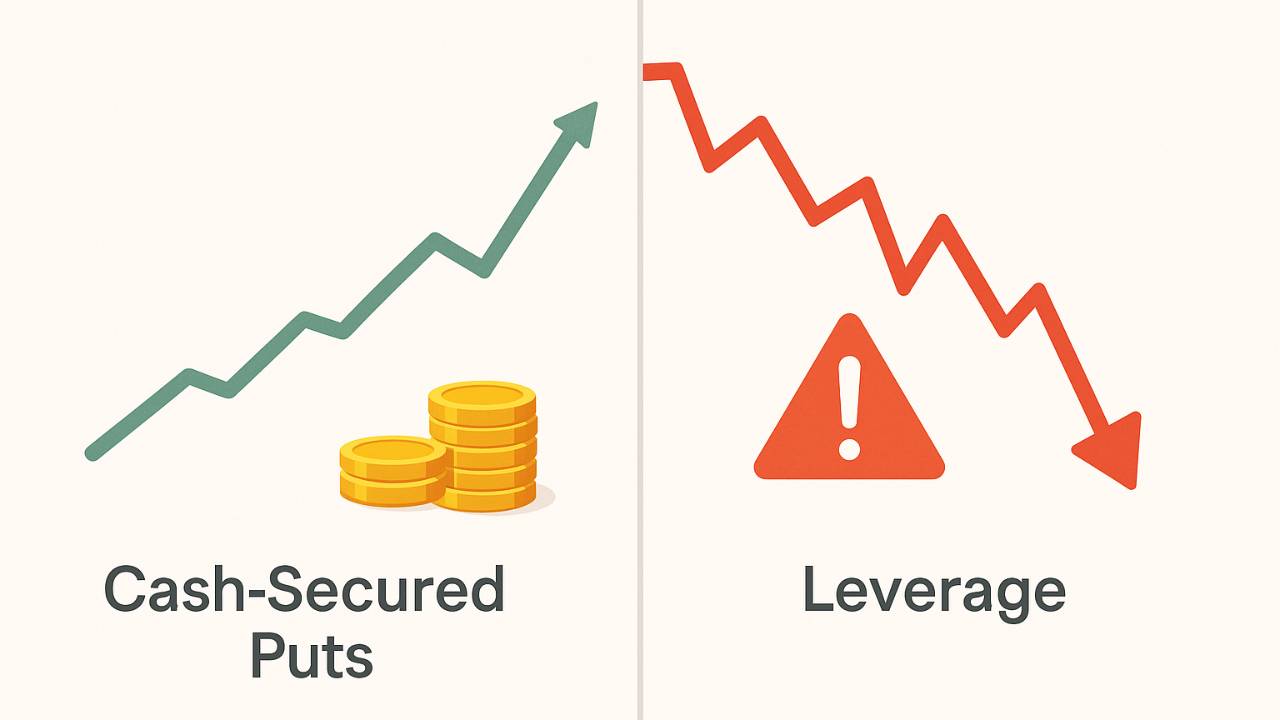
Selling puts is one of the most powerful income-generating tools in options trading. Used correctly, it can provide steady, reliable returns. Misused, it can become the financial "weapon of mass destruction" Warren Buffett famously warned about.
This article walks through what selling puts really is, how to use it safely, and the biggest pitfalls that wipe out unprepared traders.
Key Takeaways
✅ Selling puts can be safe, but only with strict rules: sell on stocks you want to own and fully cash-secure every trade.
✅ The danger is leverage. Margin lets you sell far more contracts than your cash can cover, and that is how accounts blow up.
✅ Yes, you can lose money: if the stock falls below your strike, you still buy at the strike price.
✅ You get paid upfront, you choose your entry price, and assignment can flow into covered-call income.
✅ Conservative put selling can generate 20%+ annualized returns without any leverage.
The Truth About Whether Selling Puts Is "Safe"
The honest answer: Selling put options can be safe. But only if you use strict rules around cash management and stock selection.
Here's the simple framework:
✅ Sell puts on stocks you'd be happy to own.
✅ Only sell puts you can fully cash-secure.
✅ Avoid margin while you're learning.
✅ Size positions so an assignment doesn't disrupt your portfolio.
To illustrate this, consider an example using AT&T (T). The trader observed the stock climbing above its 50-day and 200-day moving averages and decided to sell the April 16 $30 put for about $1.01 in premium.
That is a regular, conservative short put. Ten contracts require $30,000 in security, and the trader had the cash on hand. If assigned, they'd own 1,000 shares and begin selling covered calls while collecting dividends.
That's what safe put-selling looks like.
When Selling Puts Becomes Dangerous
Selling puts turns dangerous the moment you introduce leverage.
The same trader with $311,000 in cash could legally sell 394 contracts of the same put, exposing themselves to a potential $1.18 million assignment.
That is how people blow up their accounts.
The risk isn't selling puts. The risk is using margin to sell more puts than you can afford to lose.
You can avoid nearly every horror story in options trading by sticking to one rule:
If the stock is assigned at the strike price, you must be able to pay for it in cash.
Can You Lose Money Selling Put Options?
Yes. Absolutely.
When you sell a put, you take on the risk of the stock falling below your strike price. If AT&T fell from $30 to $20, a short $30 put seller is still obligated to buy shares at $30.
That's a $10 loss per share, partially reduced by the premium collected.
The good news is that experienced put sellers manage this risk in three ways:
⚡ They only choose stocks they're comfortable owning long-term.
⚡ They size positions so a drawdown is manageable.
⚡ They use adjustment strategies when trades move against them.
Selling puts is not a risk-free income strategy. But when it's used intentionally, it becomes one of the most reliable tools in options trading.
Why Traders Sell Put Options
Despite the risks, selling puts remains a favorite strategy for many traders, especially those generating consistent income.
Here's why:
You Get Paid Up Front
When you sell a put, the premium is credited to your account instantly.
If you sold 10 contracts and collected $1.01 per share, you would immediately receive $1,010.
You Choose Your Own Entry Price
Selling a $30 put means you're effectively saying:
"I want to buy this stock at $30. And if I don't get it, I'll still get paid."
It's one of the only strategies where you either:
⚡ Get paid for trying to buy a stock you like or
⚡ Get the stock at a discount
You Can Generate Covered Call Income If Assigned
If you do get assigned shares, you can immediately switch to covered calls, stacking income on top of dividends.
This is precisely how professional income traders think about put-selling. It's a two-step cash flow model.
Returns Can Be Large Without Using Margin
In the AT&T example, the trader generated an annualized return of over 20 percent without leverage.
Safe, steady, scalable.
How Beginners Should Approach Selling Puts
If your account is small, you might feel pressure to use margin. Don't. Instead:
✅ Choose lower-priced stocks
✅ Sell strikes far below the current price
✅ Keep your position sizes small until you build consistency
You can always scale up later. You only get one account.
Final Thoughts
Selling put options is an excellent strategy, but only when you follow disciplined rules. Cash-secure your trades. Pick stocks you want to own. Avoid oversized positions. And never let margin tempt you into selling more than you can afford.
Traders who treat selling puts as controlled income thrive. Traders who treat it like a shortcut blow up.
Options trading is a game you want to play forever. Use put-selling wisely, and you'll stay in the game long enough to see it work.
Frequently Asked Questions About Put-Selling Safety
Is selling put options risky?
The strategy itself is conservative when cash-secured on quality stocks. The risk comes from margin: selling more contracts than you could afford to be assigned on turns a steady income strategy into an account-threatening bet.
What is the safest way to sell puts?
Follow four rules: sell puts only on stocks you would be happy to own, fully cash-secure every contract, avoid margin while learning, and size positions so an assignment does not disrupt your portfolio.
Can you lose money selling puts?
Yes. If the stock drops below your strike, you are obligated to buy at the strike price, partially offset by the premium collected. Managing position size and choosing stocks you want anyway keeps that loss survivable.
What happens if my short put is assigned?
You buy 100 shares per contract at the strike price. Many income traders then sell covered calls against those shares, turning assignment into the second step of a cash-flow strategy.
Want the full framework for selling puts safely: position sizing, stock selection, and adjustments? That's exactly what we teach inside the Options Trading in 21 Days course.
Stay Connected!
Join our mailing list to get notified of all new blog posts, and receive the latest news and updates from our team.
