
The Wheel Strategy: A Complete Options Income System
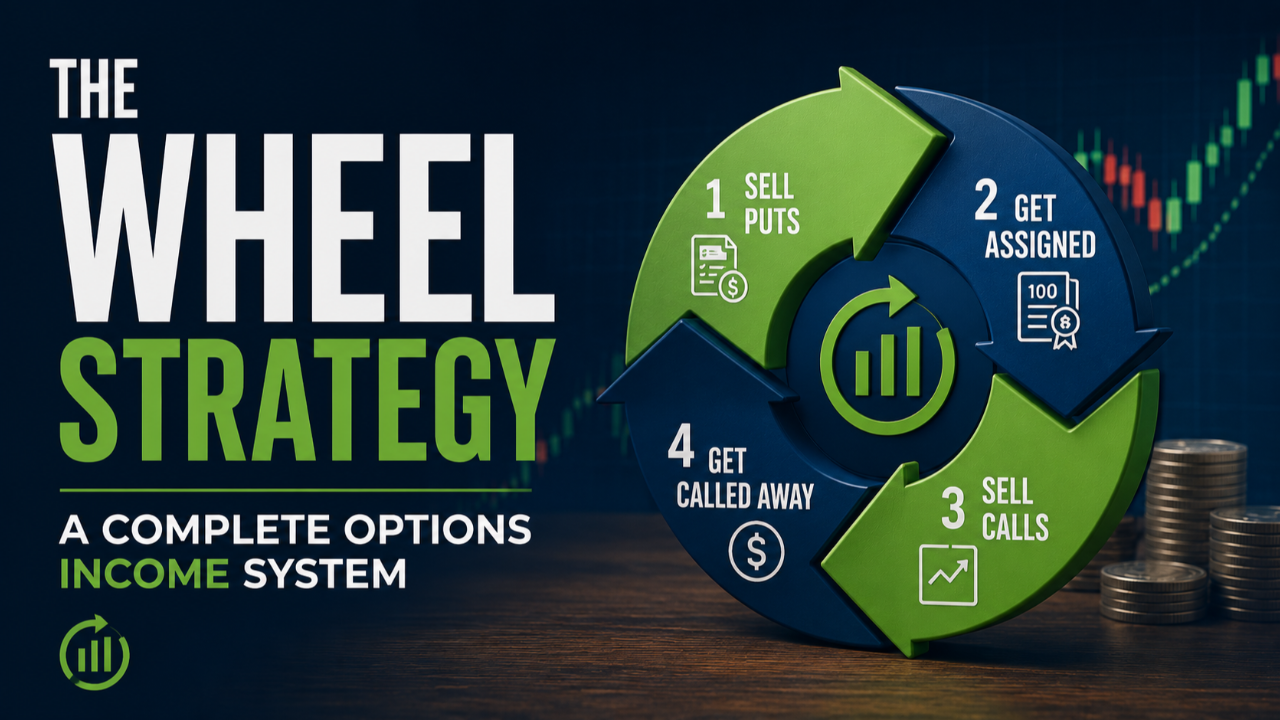
The wheel strategy is a repeating cycle: sell cash-secured puts on a stock you want to own, and if you get assigned, sell covered calls on those shares until they get called away. Then you start over with cash. Every step collects premium, which is why traders use the wheel as a mechanical income system rather than a one-off trade.
Last week we covered the cash-secured put strategy, which pays you to wait for a stock at your price. There's a companion strategy, the covered call, that pays you to hold a stock you already own.
The wheel strategy connects them into a single loop. Sell puts until you own the shares. Sell calls until you don't. Collect premium at every stage.
That's the whole idea, and its appeal is that it turns options income into a process you can repeat instead of a trade you have to time.
In this guide, you'll learn how the wheel strategy works phase by phase, walk through a complete cycle with real numbers, see how to choose stocks that suit it, and understand the one scenario that causes most wheel traders trouble.
Key Takeaways
✅ The wheel is a repeating cycle: sell cash-secured puts until you are assigned, then sell covered calls until your shares are called away.
✅ Every leg of the cycle collects premium, which is what makes the wheel an income strategy rather than a directional bet.
✅ Assignment is not a failure here. It is the handoff from the put stage to the call stage.
✅ Stock selection carries the whole strategy, so run it on quality companies you are willing to hold through a drawdown.
✅ Stop-loss orders fit the wheel badly. Manage risk with position sizing, written exit rules, and a cap on how many cycles you will run.
What Is the Wheel Strategy?
The wheel strategy (sometimes called the triple income strategy) is a cycle with three positions and two possible transitions.
You begin holding cash and selling puts. If a put is assigned, you hold shares and start selling calls. If a call is assigned, your shares are sold and you're back to holding cash.
The cycle looks like this:
- Phase 1: Sell a cash-secured put on a stock you'd be glad to own. Collect premium.
- Phase 2: If the stock stays above your strike, the put expires worthless and you repeat Phase 1. If it falls below, you're assigned 100 shares.
- Phase 3: Now that you own shares, sell a covered call against them. Collect premium again.
- Phase 4: If the stock stays below the call strike, the call expires worthless and you repeat Phase 3. If it rises above, your shares are called away at the strike and you return to Phase 1.
Notice that you never need to predict direction precisely. You need a stock you're willing to own, and you need to be paid at each step. The Options Industry Council classifies both legs, the cash-secured put and the covered call, as neutral-to-bullish strategies, which tells you what the wheel wants: sideways to modestly higher markets.
How the Wheel Strategy Works, Step by Step
Step 1: Pick the stock first, not the premium. Because the wheel can leave you holding shares for months, the stock decision matters far more than the option decision. If you wouldn't want to own it through a bad quarter, it doesn't belong in your wheel.
Step 2: Sell a cash-secured put. Choose a strike at or below where you'd happily buy, keep enough cash to buy 100 shares, and target an expiration 20 to 45 days out. That window captures the steepest part of time decay, which works in your favor as the seller.
Step 3: Handle assignment as a plan, not a problem. If the stock closes below your strike, your cash converts into 100 shares. That's not the strategy failing. That's the strategy advancing to its next phase.
Step 4: Sell a covered call above your cost basis. This is the step where most of the discipline lives. Your cost basis is the strike you paid minus every dollar of premium collected so far. Selling a call below that number locks in a loss if the shares get called.
Step 5: Repeat, and keep score by the cycle. One rotation of the wheel usually takes two to four months. Judge the strategy across full cycles, not by any single expiration.
Wheel Strategy Example: One Complete Cycle
Let's carry forward the exact trade from last week's cash-secured put guide so you can see the full loop.
A stock you like is trading at $55, and you're comfortable owning it at $50.
Phase 1: Sell the put. You sell a one-month $50 put for $1.50 per share and collect $150. Your broker reserves $5,000.
Phase 2: Assignment. The stock drifts down and finishes at $47. You're assigned 100 shares at $50, spending your $5,000.
Your cost basis is not $50. It's the strike minus the premium you kept: $50 minus $1.50, which equals $48.50 per share.
Phase 3: Sell the covered call. You now own 100 shares with the stock at $47. You sell a one-month $50 call for $1.10 and collect another $110.
Note the strike choice. The $50 call sits above your $48.50 cost basis, so if the shares get called away you still book a small gain on the stock. Your cost basis now drops again: $48.50 minus $1.10, which equals $47.40 per share.
Phase 4: The shares get called away. The stock recovers to $52 by expiration. Your 100 shares are sold at $50, returning $5,000 in cash.
Now total the cycle:
- Put premium: $150
- Call premium: $110
- Stock proceeds: $5,000 against a $5,000 purchase, so no capital gain or loss
- Total profit: $260 on $5,000 of committed capital, roughly 5.2% over two months
You're back to cash, ready to sell another put and start the wheel again.
One important caution: it's tempting to multiply that 5.2% by six and advertise a 31% annual return. Don't. That figure assumes every cycle completes cleanly, and the cycles that go wrong are exactly the ones that take longest to resolve.
What if the stock had kept falling? Say it slid to $40 instead of recovering. Your $50 call expires worthless, you keep the $110, and you sell another call next month. But with a $47.40 cost basis and the stock at $40, any call struck above your basis pays very little. You're now holding a losing position and collecting small premium while you wait. Against $260 collected, you'd be sitting on roughly $740 of unrealized loss. This is the scenario that defines the wheel's real risk, and it's why the stock you choose matters more than the premium you collect.
The Wheel Strategy vs. Buying and Holding
Compare two investors who both liked that $55 stock.
The first buys 100 shares outright for $5,500. The second runs the wheel as described above.
If the stock chops sideways or dips and recovers, the wheel wins. It generated $260 in premium while the shareholder collected nothing but price movement.
If the stock rallies hard to $70, the shareholder wins decisively. They're up $1,500. The wheel trader collected $260 and had their shares called away at $50, missing the entire move.
If the stock falls to $40 and stays there, both lose, but the wheel trader loses slightly less because the premium collected cushions the decline.
That's the honest trade-off. The wheel exchanges your upside for consistency. It performs best in flat, choppy, or mildly rising markets, and it underperforms badly in strong bull runs. Anyone selling the wheel as a strategy that beats the market in all conditions is skipping the part where your gains are capped by design.
Choosing the Best Stocks for the Wheel
Because assignment is a feature of this strategy rather than an accident, the stock you pick effectively is the strategy. Everything else is mechanics.
Start with a blunt test. If the premium vanished tomorrow and you were left holding 100 shares for a year, would that be acceptable? If the answer is no, the ticker fails before you look at a single strike.
Stability over excitement.
Look for predictable revenue, a track record through more than one market cycle, and no dependence on a single upcoming event. Large, established names with modest growth expectations tend to wheel well precisely because their price ranges are narrower.
Liquidity you can actually trade.
Check that the options chain shows tight bid-ask spreads and meaningful open interest at the strikes you want, 20 to 45 days out. Wide spreads quietly tax every entry and exit, and on a strategy that trades this often, that cost compounds.
Moderate implied volatility.
This is the criterion that trips people up. High IV pays more, and it pays more because the market expects a larger move. A moderate IV name gives you a smaller premium and a much better chance of the sideways drift the wheel actually wants.
A share price that fits your account.
Every contract commits you to 100 shares. A $300 stock demands $30,000 per cycle. Choosing a $30 to $60 name is often less about preference and more about whether one position would dominate your account.
What to avoid: recent IPOs with no trading history, biotech names awaiting trial or FDA decisions, heavily shorted or social-media-driven tickers, companies in visible financial distress, and anything with an earnings report inside your expiration window.
A useful final filter: if you cannot explain in two sentences why the business will still be here in three years, don't wheel it.
Risks of the Wheel Strategy
Holding a falling stock.
This is the risk that matters. The wheel has no mechanism to get you out of a deteriorating company. It hands you shares and then pays you modest premium while the position works against you. Every wheel trader eventually gets stuck in one, and how you handle it determines your results more than any winning cycle does.
Capped upside.
Selling calls means agreeing to a maximum sale price. In a strong rally you'll watch the stock run past your strike while your shares leave at a fixed number.
Capital intensity and concentration.
Each rotation ties up the cash for 100 shares. On a $50 stock that's $5,000 committed to one ticker for months, which can quietly turn a diversified account into a concentrated one. If your account is smaller, review our guide to trading options in a small account before running a full wheel.
Tax drag.
The wheel generates frequent short-term premium and short-term stock sales. In a taxable account, that income is generally taxed at short-term capital gains rates, which can meaningfully reduce your net return. Our guide to options taxes covers the details, and confirming your situation with a tax professional is worth the time.
Early assignment.
Short options can be assigned before expiration, most often on calls just before a dividend goes ex. FINRA's overview of options is a useful primer on how assignment mechanics work in practice, and the SEC's investor guidance on options covers the underlying contract rights.
Managing the Risk in Practice
The wheel gives you three real levers, and none of them is a stop loss.
Position size, decided first.
Set the maximum you will commit to any single ticker before you look at premium, and express it as a percentage of the account rather than a dollar figure. Most people who get hurt by the wheel were not wrong about the stock, they were simply too large in it.
Written exit conditions.
Before entry, record what would make you close rather than accept assignment: a broken thesis, a dividend cut, withdrawn guidance, or a decline past the level where you genuinely no longer want the shares. Rolling the put out in time is frequently the better move than taking assignment on a name you have soured on.
A cycle limit.
Decide in advance how many consecutive covered calls you will sell against a losing position before you accept the loss and redeploy the capital. Without that rule, one bad wheel can occupy the same $5,000 for years while you tell yourself you are still collecting income.
A note on stop-loss orders, since they get recommended often: they fit the wheel badly. A stop on the shares defeats the premise, because being assigned is the plan, and stops on short options fill unreliably in thin markets. Sizing and written exit rules do the work a stop would do in a directional trade.
Common Mistakes to Avoid
Wheeling a stock you don't want to own.
The most common and most expensive error. Screening for the highest premium will reliably route you into the stocks most likely to keep falling.
Selling calls below your cost basis.
If you were assigned at $50 with a $48.50 basis, selling a $45 call to grab premium guarantees a loss on the shares if they're called. When no strike above your basis pays enough, the right answer is usually to wait rather than to lock in the loss.
Sizing by premium instead of assignment value.
Every put you sell is a commitment to buy 100 shares. Size by the $5,000 you might spend, not the $150 you might collect.
Ignoring earnings dates.
A single earnings gap can drop a stock below your strike overnight and start your cycle in a hole. Check the calendar before you sell.
Treating the wheel as set and forget.
Cycles run for months, and company stories change inside them. Decide in advance what would make you exit the position entirely, including rolling the put or closing it at a small loss before assignment.
Tracking Wheel Strategy Performance
The wheel produces a lot of small transactions, which makes it unusually easy to feel profitable while standing still. A simple log fixes that.
Track one row per cycle, not per trade. At minimum, record the ticker, the date opened, the strike and premium of every option sold, whether you were assigned, your running cost basis, the date the cycle closed, and total premium collected.
Then calculate three numbers.
Return on committed capital.
Total premium, plus or minus any stock gain, divided by the cash the position actually tied up. In our example that was $260 on $5,000, or 5.2%. This is the only figure that lets you fairly compare a wheel against simply holding the shares.
Days committed.
A 5% return over two months and a 5% return over ten months are different businesses. Recording how many days each cycle occupied tells you which names are worth repeating.
Unrealized position drag. For any open cycle where you're holding shares below your cost basis, record that gap. This is the number people leave out of their mental accounting, and it's usually the difference between a strategy that works and one that only looks like it works.
A spreadsheet is enough. Tracking software is fine, but the discipline matters more than the tool.
Review the log quarterly and ask one question: which tickers produced clean cycles, and which ones tied up capital? Most traders discover that a small number of names account for most of their trouble, and that pattern is only visible when it's written down.
Frequently Asked Questions
Is the wheel strategy profitable?
It can be, in flat to modestly rising markets on quality stocks. Its profits come from premium collected across many cycles, not from any single trade. Its weakness is well documented: capped upside during rallies, and no exit mechanism when a stock declines. Profitability depends far more on stock selection and position sizing than on strike selection.
How much money do you need to run the wheel strategy?
Enough to buy 100 shares at your put strike. A $20 stock needs roughly $2,000 per contract; a $50 stock needs $5,000. Because the capital stays committed for months, most traders want several times that so a single wheel doesn't dominate the account.
What is the best stock for the wheel strategy?
Boring and stable beats exciting. Look for companies you'd hold for years, liquid options chains, moderate implied volatility, a share price your account can absorb, and no imminent binary events. Stocks with enormous premium are usually the ones most likely to leave you holding a loss.
What happens if the stock drops a lot?
You keep the shares and the premium collected, and you continue selling calls, but only at strikes above your cost basis. Realistically you may hold the position for a long time. This is the wheel's core risk and the reason to only run it on companies you genuinely want.
Should you sell a covered call below your cost basis?
Generally no. It converts an unrealized loss into a realized one if the shares are called. Waiting for a better strike, or accepting that the position needs time, is usually better than harvesting small premium at the cost of a locked-in loss.
Is the wheel strategy better than buying and holding?
In sideways and choppy markets, often yes. In strong bull markets, no, because your upside is capped at your call strike. It's a different risk profile, trading potential appreciation for steadier income.
How is the wheel strategy taxed?
Premium is generally a short-term capital gain when the position closes, and assignment adjusts your cost basis rather than creating an immediate taxable event. Frequent cycles produce mostly short-term gains, which is why many traders run the wheel inside a retirement account where the tax drag disappears.
Can you run the wheel in an IRA?
Many brokers permit cash-secured puts and covered calls in IRAs because both are fully collateralized, though approval levels and rules vary by broker. Since the wheel is tax-inefficient in a taxable account, an IRA is often the more sensible home for it.
Final Thoughts
The wheel strategy is appealing because it replaces prediction with process. You get paid to wait for a stock, paid to hold it, and paid again when it leaves. Every phase has a defined next step.
What the wheel does not do is protect you from a bad stock. It has no stop loss built in, and its structure quietly encourages you to keep holding while collecting small premium. Run it on companies you'd be content to own for years, size positions by what assignment will actually cost, and never sell calls below your cost basis just to book premium.
Do those three things, and the wheel becomes what its reputation promises: a repeatable income system rather than a slow way to accumulate losing positions.
Ready to run your first full cycle with someone checking your strikes? Options Trading in 21 Days walks you through selling puts and covered calls step by step, in order.
About the Author
Kevin Amell is the founder and instructor of Options Trading in 21 Days, an online course that teaches beginners to trade options in a structured 21 day sequence, and he publishes The Resilient Trader newsletter. He also works directly with students through one on one options coaching.
Educational content only. Nothing here is individualized investment advice. Options involve risk and are not suitable for every investor.
Stay Connected!
Join our mailing list to get notified of all new blog posts, and receive the latest news and updates from our team.
