
Best Stocks for Selling Puts (and How to Screen for Them)
Ask ten traders for the best stocks for selling puts and you will get ten ticker lists, most of them copied from whatever screener ranks premiums highest. That is exactly backwards. After 22 years trading derivatives, I can tell you the most expensive mistake in put selling is not a bad strike or a bad expiration. It is running the right strategy on the wrong stock.
So this article will give you something more durable than a list: the screen. Five traits that make a stock right for put selling, the red flags that disqualify one, and the reason the highest-premium names are usually the worst candidates on the board.
Key Takeaways
✅ The first filter is non-negotiable: only sell puts on stocks you would genuinely be happy to own.
✅ Screen for liquidity: tight bid-ask spreads, open interest above 1,000, and heavy daily share volume.
✅ Moderate volatility is the sweet spot; sky-high premium is a price tag on risk, not a gift.
✅ Match the stock price to your account so one assignment cannot swamp you.
✅ Avoid binary-event names: biotechs before FDA decisions, anything inside its earnings window.
Start With the Only Question That Matters
Every put you sell is a promise to buy 100 shares, and the Options Industry Council's cash-secured put guide lays out the maximum gain, maximum loss and breakeven of that promise. So the first screen is brutally simple: would you be happy owning this company at the strike price? Not tolerating it. Happy.
If the answer is no, nothing else about the stock matters, because the whole strategy rests on assignment being a good outcome. The moment you find yourself selling a put on a company you would never hold, you have stopped running an income strategy and started collecting pennies in front of a steamroller. Everything in keeping put selling safe flows from this one filter.
The Five-Point Screen
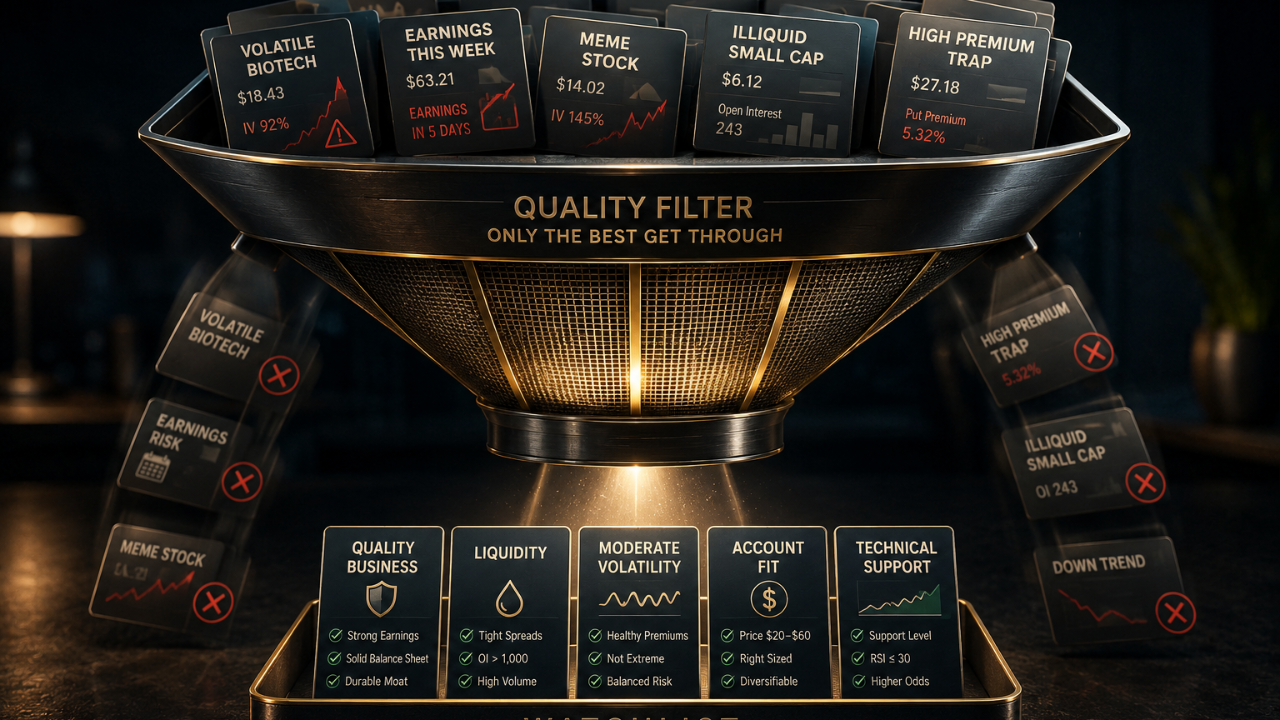
1️⃣ Business quality you can explain. Steady earnings, real cash flow, a reason to exist in ten years. Think of the kind of established large caps and index ETFs you would hold anyway. Boring is a feature: the strategy makes its money on stocks that do not surprise anyone.
2️⃣ Options liquidity. Check the chain before anything else: bid-ask spreads of a few cents, open interest above 1,000 on the strikes you would use (see the SEC's Investor.gov definition of open interest), and daily stock volume in the millions of shares. Wide spreads quietly tax every entry, exit, and roll, and in this strategy you transact every month.
3️⃣ Moderate implied volatility. Enough that the premium is worth collecting, not so much that the market is bracing for a violent move. A useful sanity check: if the 30-day put at a conservative strike pays under about half a percent of the strike, the stock is too sleepy; if it pays several percent, ask what the market knows that you do not.
4️⃣ A price that fits your account. One contract at a $45 strike means $4,500 of secured cash. For most accounts, stocks roughly in the $20 to $60 range let you diversify across several names instead of betting the account on one assignment. Smaller accounts should lean toward the lower end and ETFs.
5️⃣ Visible technical support. Sell strikes below a level the stock has defended, and the odds tilt further your way. A price floor plus an RSI near or below 30 is the classic setup: an oversold quality stock sitting on support is the best put-selling candidate the market produces.
Why the Highest Premiums Are a Warning, Not a Prize
Premium screeners will happily show you stocks paying 5% or more for a single month of put selling, and beginners see free money. Here is what I have seen over and over, both in my own early trading and in every student who tried it: the premium is high because the market believes the stock can fall hard, and the market is usually right.
Implied volatility is the market pricing risk. When you sell the fat premium, you are not outsmarting anyone; you are volunteering to hold the risk everyone else is paying to get rid of. Occasionally that works. Across a year of trades, the blown-through strikes eat the extra premium and then some.
The discipline that actually compounds is the opposite: ordinary premiums on extraordinary companies, repeated monthly with a system, at conservative deltas around 0.20 where the odds run roughly 80% in your favor.
Stocks and Situations to Avoid
🔴 Binary-event names. Biotechs in front of FDA decisions are my standing example: one headline can cut the stock in half, and no support level survives it. The same logic covers litigation verdicts and merger votes.
🔴 Anything inside its earnings window. If the company reports before your expiration, either sell after the report or pick a different name that month.
🔴 Meme and momentum stocks. Spectacular premiums, no relationship between price and value, and gaps that skip straight past your strike. The trade may work five times and then erase all five.
🔴 Falling knives. A downtrending stock at a "cheap" price is not support, it is gravity. Wait for the base to form; the puts will still be there, usually still paying well.
🔴 Illiquid small caps. Even good businesses fail the screen if the options barely trade. You will give back a year of edge crossing wide spreads.
Building Your Watchlist
You do not need fifty candidates. You need five to ten names that pass every screen, that you would own at the right price, and that you get to know month after month: where their supports sit, when they report, how their premiums breathe with the market. Familiarity is an edge no screener sells.
My process, once the list exists, is the same monthly rhythm every time: confirm no earnings inside the window, find the support, sell near the 0.20-delta strike 28 to 30 days out, cash-secured, sized so any single assignment is comfortable. The mechanics are step-by-step in how to sell a put option, and if assignment comes, the shares flow straight into covered calls and the wheel.
Frequently Asked Questions About Picking Stocks for Put Selling
What are the best stocks for selling puts?
Liquid, financially steady large caps and index ETFs that you would happily own at your strike price, with tight option spreads, open interest above 1,000, moderate implied volatility, and no earnings or binary events inside the expiration window. The best list is short, familiar, and boring.
Are high-premium stocks good for selling puts?
Usually the opposite. Premium is the market's price on risk, so an outsized premium means the market expects the stock can fall hard. Selling it means holding the risk others are paying to shed. Consistent put sellers take ordinary premiums on quality names instead.
Are ETFs better than stocks for selling puts?
ETFs like broad index funds remove single-company risk, trade with excellent liquidity, and never have earnings gaps, at the cost of somewhat lower premiums. They are the cleanest starting point for new put sellers and a permanent core for many experienced ones.
How many stocks should be on a put-selling watchlist?
Five to ten. Enough to always have a candidate near support with clean premiums, few enough that you truly know each name's behavior, report dates, and levels. Depth of familiarity beats breadth of scanning in this strategy.
Want the full screening checklist applied to live trades? Join us in the Options Trading in 21 Days course.
Final Thoughts
The best stock for selling puts is one you would be glad to own, priced where the options market pays you fairly to wait for it. Build the short list, respect the red flags, and let the premium screeners keep tempting somebody else. This is an owner's strategy, and it rewards traders who choose stocks like owners.
The examples in this article are educational illustrations, not recommendations to buy or sell any security.
Keep Learning
📘 Selling Puts Strategy: How to Get Paid to Wait
📘 How to Sell a Put Option: Easy Steps to Get Started
📘 The 3 Technical Indicators That Stack the Odds in Your Favor
Screen like an owner, sell like the house: the Options Trading in 21 Days course.
Stay Connected!
Join our mailing list to get notified of all new blog posts, and receive the latest news and updates from our team.
