
The Collar: A Covered Call With a Protective Put
The covered call has one honest weakness: the premium cushions a small dip and does nothing about a real fall. If your stock drops 20%, the $95 you collected is a consolation prize.
The fix is older than most trading software: pair the covered call with a protective put, and let the call's income pay for the put's insurance. Traders call the combination a collar, and after 22 years of trading derivatives, it is the structure I reach for whenever the job is protecting a position rather than just milking it for income.
Key Takeaways
✅ A collar = 100 shares + a short call above the price + a long put below it. The call you sell pays for the put you buy.
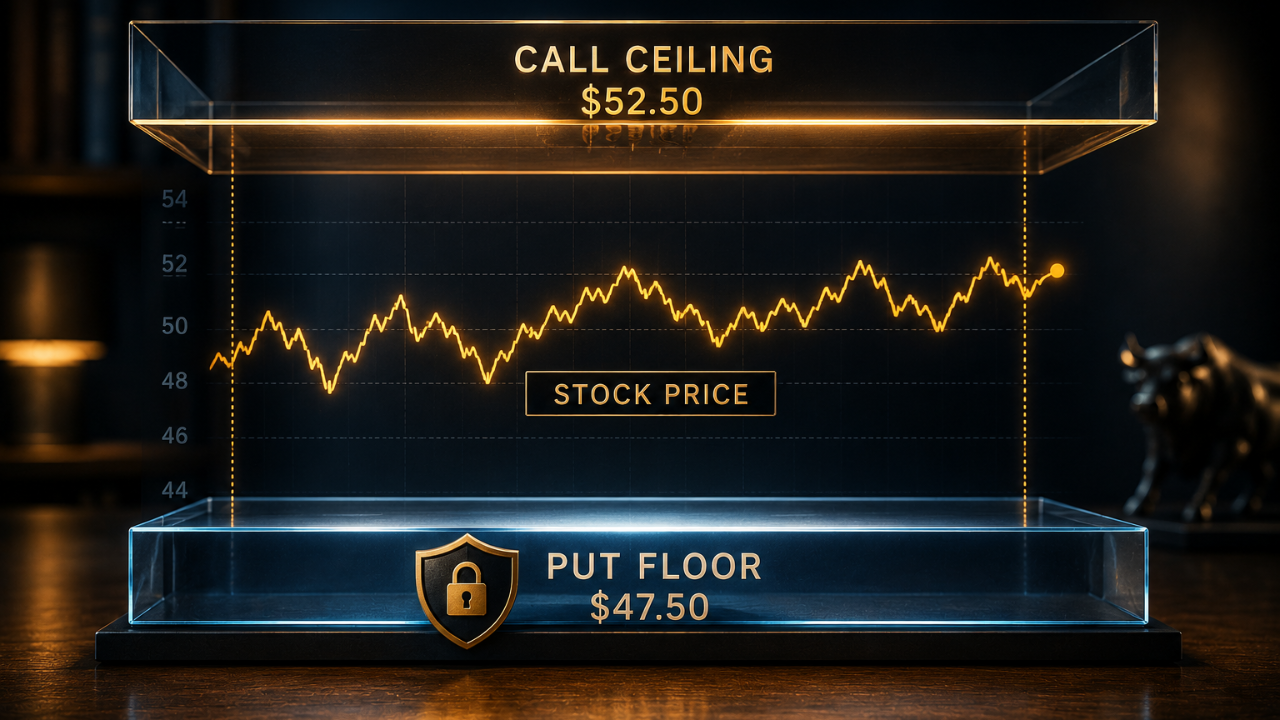
✅ It puts a floor under your losses and a ceiling on your gains, both known to the dollar before you enter.
✅ A "zero-cost collar" chooses strikes so the call premium fully covers the put cost: free insurance, paid for with upside.
✅ Best for protecting large gains, concentrated positions, or holdings you cannot or will not sell yet.
✅ The cost is opportunity: in a strong rally, a collared position deliberately underperforms.
How a Collar Works
A collar has three parts, all sharing one expiration:
1️⃣ Own 100 shares of the stock.
2️⃣ Sell a call above the current price, exactly as you would in a standard covered call. This brings in premium.
3️⃣ Buy a put below the current price. This costs premium, and it gives you the right to sell your shares at that strike no matter how far the stock falls.
The short call finances the long put. Above the call strike, your shares get called away: that is your ceiling. Below the put strike, your losses stop: that is your floor. Between the two, you simply own the stock, usually with a small credit or debit from the difference in premiums.
A Worked Example
You own 100 shares of a stock trading at $50.00, and options are about 30 days out:
⚡ Sell the $52.50 call for $0.95
⚡ Buy the $47.50 put for $0.85
⚡ Net credit: $0.10 ($10 in your pocket to open the position)
Now every outcome is known in advance:
✅ Stock rallies past $52.50: your shares sell at $52.50. You make $250 on the stock plus the $10 credit. That is your maximum, no matter how high the stock goes.
✅ Stock sits between $47.50 and $52.50: both options expire, you keep your shares and the $10, and you can build next month's collar.
✅ Stock collapses to $40, or $30, or anywhere: your put lets you sell at $47.50. Your maximum loss is $250 minus the $10 credit, $240, period. A shareholder without the collar would be down $1,000 at $40.
That defined band, roughly minus $240 to plus $260 on a $5,000 position, is the entire point. You have converted an open-ended risk into a bracket.
The Zero-Cost Collar
When the call premium fully pays for the put, traders call it a zero-cost collar: downside insurance with no cash outlay. Our example, taken at a $0.10 credit, qualifies.
Understand what "free" means here, because nothing in markets is actually free. You paid for the put with your upside beyond $52.50. In a flat or falling market that trade-off is brilliant. In a monster rally it will feel expensive, and this is where I repeat the warning I give about every capped-upside strategy: do not collar your highest-conviction growth names. I capped a runaway winner early in my career expecting it had run out of road, and the upside I handed away exceeded years of collected premiums. Collar the positions you want to protect, not the rockets.
When a Collar Is the Right Tool
📌 Protecting a large unrealized gain. A stock has doubled and you are not ready to sell, for tax timing or conviction. A collar locks in most of the gain while you wait, and the tax treatment of the exit stays on your schedule.
📌 A concentrated position you cannot diversify yet. Employer stock, inherited shares, a position too large to sell at once. The collar caps the damage a single name can do.
📌 Nervous markets. When you want to stay invested but volatility is elevated, collars let you hold through the storm with a known worst case, one of several hedge strategies for protecting a portfolio.
📌 Approaching a date that matters. Retirement, a house purchase, tuition. When the money has a job soon, the floor matters more than the ceiling.
Collar vs Covered Call vs Protective Put
The three structures are siblings, and choosing is about which risk bothers you most:
⚡ Covered call alone: maximum income, small cushion, no floor. Right when your worry is stagnation, not collapse. Its true costs are covered in the risks of covered calls.
⚡ Protective put alone: full upside, real floor, but you pay the entire insurance bill, which drags on returns year after year.
⚡ Collar: the floor of the put, the income of the call netting against its cost, and a capped ceiling as the price. Right when protection matters and you can live without the home run.
One more sibling worth knowing: run the numbers on your call side with the covered call calculator first, because a collar is only as good as the call premium funding it.
Frequently Asked Questions About Collars
What is a collar in options trading?
A three-part position: 100 shares of stock, a call sold above the current price, and a put bought below it. The call premium offsets the put cost, creating a known floor and ceiling for the position until expiration.
What is a zero-cost collar?
A collar whose strikes are chosen so the call premium equals or exceeds the put cost, making the net outlay zero or a small credit. The insurance is paid for entirely with surrendered upside rather than cash.
What is the downside of a collar?
Opportunity cost. If the stock rallies hard, your gains stop at the call strike while an unhedged shareholder keeps everything. Collars also require managing two option legs, and early assignment on the call side is possible around ex-dividend dates.
When should I use a collar instead of just a covered call?
When a real decline would genuinely hurt you: a large gain you need to protect, a concentrated position, or money with a near-term purpose. If you could hold through a 30% drawdown without flinching, the covered call alone keeps more income. If you could not, buy the floor.
Learn when each structure fits, with real trades: the Options Trading in 21 Days course.
Final Thoughts
The collar is what a covered call grows up into when the position starts to matter. You give away the top slice of a rally you may never see, and in exchange you know, to the dollar, the worst thing that can happen to you. For protecting gains, concentrated stock, or money with a deadline, that trade is usually a bargain.
Keep Learning
📘 How to Sell a Covered Call: A Comprehensive Guide
📘 3 Option Hedge Strategies to Protect Your Portfolio
📘 Covered Call Calculator: Know Your Return Before You Trade
Floors, ceilings, and the income in between: the Options Trading in 21 Days course.
Stay Connected!
Join our mailing list to get notified of all new blog posts, and receive the latest news and updates from our team.
