
Paper Trading Options: How to Practice Until the Trade Is Boring
I traded professionally for 22 years, and I still went back and checked my trades two or three times before I hit enter. Sometimes I would read the order back to myself out loud. That habit did not come from being careful by nature. It came from watching what happens when real money goes in the wrong way, and from knowing that the cheapest place to learn every one of those lessons is a paper trading account.
Paper trading options is the part of learning that most people want to skip. It is not exciting, the money is not real, and it feels like a detour between the course and the "real" trading. It is the opposite. It is where the real learning happens. This article covers what paper trading is actually for, how I tell students to use it, how long to stay there, and the questions I ask before anyone moves to live money.
Key Takeaways
✅ Paper trading is where you make mistakes without consequences. Buying the wrong expiration, the wrong leg of a spread, or a put instead of a call costs nothing here and real money everywhere else.
✅ The goal is not to make money. The goal is to place the trade correctly and understand exactly what you did.
✅ Trade one contract at a time until one contract equals 100 shares is automatic in your head.
✅ You are ready to leave when you are bored: no hesitation, no mistakes, the same process every time. That is not a few days or a week.
✅ Before going live, answer four questions honestly: are you following your written rules, do you understand the risk, are you calm, and do you have a repeatable process.
What Paper Trading Is For
A paper trading account is a simulated account inside your broker's platform. It uses live market prices and the real order screens, but the money is fake. Most of the major brokers offer one, and the platforms review covers which ones do it well.
Here is what it is for. When I was doing one-on-one sessions, people would come in and say, "I tried making this trade and I bought a put when I meant to buy a call." Or, "I meant to buy the option three months out and I bought the 30-day one, and I lost money." Every one of those is an avoidable mistake, and every one of them is free in a paper account. If you mess up, it does not affect your wallet and it does not affect your portfolio.
The other thing it does is slow things down. The paper environment feels real when you are in it. You see the stock ticking up and down, you see the bid-ask spread moving while you are trying to get the order in, and you feel the urge to hurry. But there is no pressure, because nothing is at stake. You can take the time to look at the options chain, find the right expiration, pick the right strike, and read the order back before you send it. Doing that fifty times in paper is what makes it automatic when the money is real.
The Goal Is Not to Make Money
This surprises people. In the paper account, I do not care whether the trades are profitable. We are not worried about that. We are worried about two things: did you place the trade correctly, and do you understand what you did.
So the first trades are deliberately boring. Pick a stock you know. Go to the chain, look at where it is trading right now, and buy one contract at the money or slightly in the money. One contract, not ten, so that the arithmetic stays simple and you get a grasp on the fact that one contract equals 100 shares. Then look at what you own. What did you pay? What is the most you can lose? Where does it break even? The platform will show you all of that, but calculate it yourself anyway. Writing down your max profit, max loss and break-even before every trade is a habit I want built early, because it is the habit that catches the $25,000 risk you thought was $25.
That happens, by the way. You put in a call spread, your max risk should be $25, and the risk screen says $25,000. You grabbed one leg of the spread and forgot the other. The platform alerts you, but only if you are looking. Paper trading is where you learn to look.
After the first trade, I want you to feel one thing: not giddy that it executed, but clear about what you put on. If you understand it, then be happy. That is the win.
What to Practice, in Order
📌 Single calls and puts first. Buy a call. Buy a put. Watch them for a few days. Close them. Learn where the order screens are and what every field means. Call options for beginners covers the mechanics.
📌 Then the income trades. Sell a covered call against 100 paper shares. Sell a put at a 30 delta and watch what time decay does to it over 30 days. These are the trades most of my students end up living on, and they behave differently from bought options.
📌 Then spreads. A put credit spread, a call debit spread, an iron condor. Spreads are where the leg mistakes happen, so this is where the repetitions matter most.
📌 Then manage them. Roll a covered call. Close a spread at half its max profit. Let a put expire. Get assigned on purpose and see what lands in the account. Every one of those is a thing you do not want to experience for the first time with real money.
Keep the strategies simple. I have said this many times and I will keep saying it: after more than two decades, the simple trades perform better than the complicated ones. Paper trading is not the place to try a butterfly because it looks interesting. It is the place to do the same covered call twenty times until you could do it in your sleep.
How Long Should You Paper Trade?
Until you are bored of it. I mean that literally. You should be so bored of placing these trades that you are not hesitating anymore. You are not going in and thinking, "Wait, where is the chain, which expiration am I supposed to use, am I grabbing the right one?" You put the trade in cleanly, you are not making mistakes, and you are not looking at a filled order and thinking, "That is not what I was trying to do."
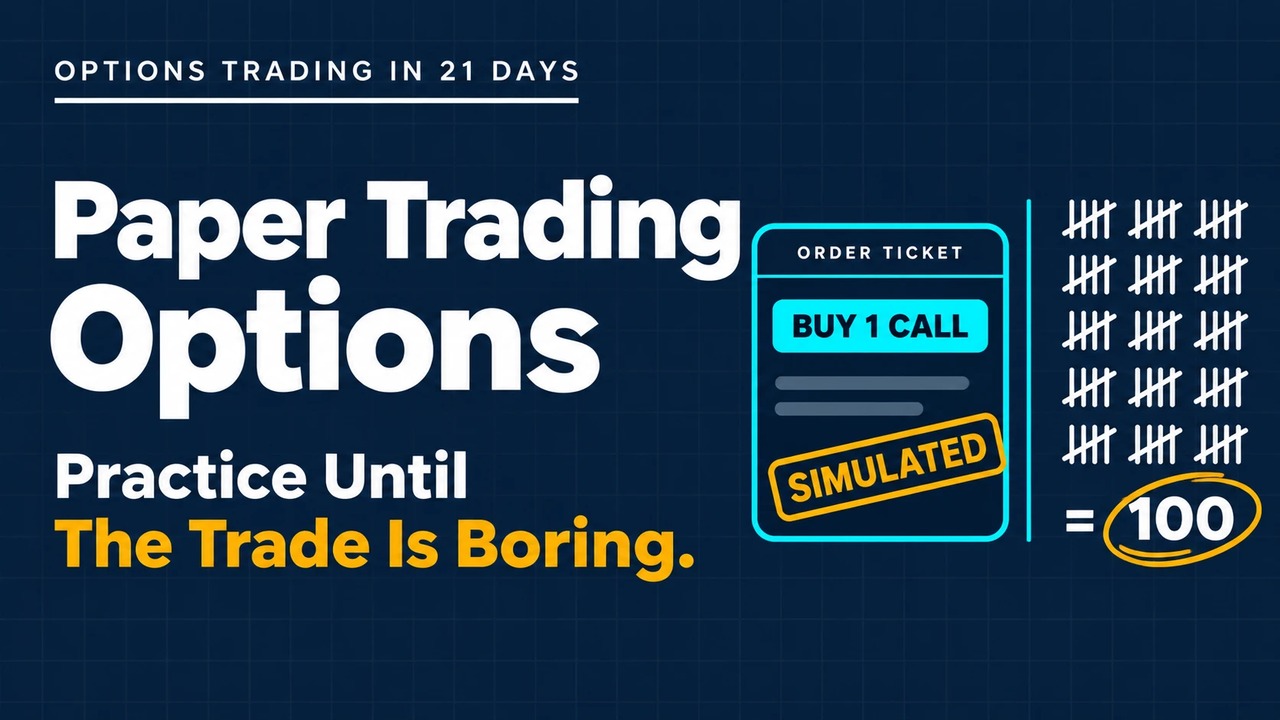
When you reach that point you have self-graduated. I guarantee it is not after a few days or a week. The expectation I set in the course is roughly a hundred trades. That sounds like a lot until you realize that the whole point is repetition. It is the same reason algebra goes from confusing to obvious: you do enough problems and the confusion wears off. Confidence in trading comes from reps, not from reading.
If you are wondering what to do with the time, the five steps before any options trade is the checklist I want running in your head on every paper trade, so that it is already automatic by the time the first real order goes in.
The Four Questions Before You Go Live
When someone asks me whether they are ready to move from paper to real money, I tell them to ask themselves a few questions and be honest about the answers.
⚡ Am I consistently following the rules I wrote down? Not most of the time. Consistently. If you have a rule about how much to risk per trade and you broke it last Tuesday because the setup looked great, you are not ready.
⚡ Do I understand the risk of what I am putting on? Say you are short a single put in paper. You have risk all the way down on a volatile stock. You sold ten contracts at a $50 strike, so you need $50,000 to buy the stock if you are assigned. Do you have that in the portfolio? In a million-dollar account, that is probably fine. In a $20,000 account, that is far too much risk, and you should be selling a put spread instead. If you cannot answer that question for every open paper position, stay in paper.
⚡ Am I calm? This sounds funny, but it matters. Are you calm putting these trades on and watching them, or are you emotional? The honest complication is that paper money makes everyone braver. I am guilty of it myself. You take a little more risk because it is not real. So the question is not whether you are calm in paper. It is whether you would be calm if the number on the screen were yours.
⚡ Do I have a repeatable process? If you are trading income, are you selling put spreads, call spreads, iron condors, some combination, and do you do it the same way each time? If you are trading direction, how are you finding the stocks? What has to be true before you enter? If the answer is "it depends on how I feel that day," you do not have a process yet.
If you are answering no to any of those, stay in paper a little longer. There is no rush. You would rather learn than go lose money. The market will still be there, and the mistakes that take beginners out are almost all mistakes that a few more weeks of practice would have caught.
Moving to Real Money
When you do go live, go small. Trade the same one contract you traded in paper, on the same kind of stock, with the same process. Do not reward yourself for graduating by sizing up. The whole reason you spent those weeks in paper was to make the process automatic, and the fastest way to break an automatic process is to make the stakes feel different.
And keep the paper account open. I still think of it as the place to test anything new. A new strategy, a new stock, a new way of managing a position: it goes through paper first. Twenty years in, that rule has not changed, and it is one of the reasons I am still here.
The Options Industry Council offers free strategy courses that pair well with a paper account, and Investor.gov has a plain-language primer on options risk that is worth reading before your first live order. If you are not sure how much to put in that first real account, how much money you need to trade options walks through the numbers.
Frequently Asked Questions About Paper Trading Options
What is paper trading in options?
Paper trading is placing options trades in a simulated account that uses real market prices and real order screens but fake money. It lets you practice entering, managing and closing trades, including spreads and assignments, without any financial consequence for mistakes.
How long should you paper trade options before going live?
Until placing trades is boring: no hesitation, no order mistakes, the same process every time. For most people that is on the order of a hundred trades, not a few days or a week. The test is whether you consistently follow your written rules, understand the risk of every position, stay calm, and have a repeatable process.
Is paper trading realistic?
The prices and the order mechanics are real. The emotions are not, and that is its main limit. Everyone takes a little more risk with fake money. Use paper trading to make execution automatic and to understand risk, then go live with one contract so the process survives the switch to real stakes.
Should you try to make money in a paper trading account?
No. Paper profits prove very little, because the risk you took was free. The goal is to place every trade correctly, know your max loss and break-even before you click, and understand exactly what you own afterward. Judge your paper trading on process, not on the fake balance.
What should you practice first in paper trading?
Single calls and puts, one contract at a time, to learn the order screens. Then covered calls and cash-secured puts, which are the income trades most traders rely on. Then spreads, where leg mistakes happen. Then managing positions: rolling, closing early, letting options expire and being assigned.
Practice the exact routine I teach, on live chains, with a community checking your work: the Options Trading in 21 Days course.
Final Thoughts
Nobody has ever regretted spending an extra month in a paper account. Plenty of people have regretted skipping it. The lessons are the same either way. The only difference is who pays for them.
Open the paper account, trade one contract, write down the risk before every order, and keep going until it is boring. Then take the same process, unchanged, to real money.
Keep Learning
📘 How to Start Trading Options: A Beginner's Guide to Calls, Puts, and Risk
📘 3 Things You Need Before Your First Options Trade
📘 Options Trading Glossary: Essential Terms Every Trader Should Know
Build the reps with a process that is already proven: the Options Trading in 21 Days course.
Stay Connected!
Join our mailing list to get notified of all new blog posts, and receive the latest news and updates from our team.
