
Bull Call Spread: Cap the Upside, Cut the Cost
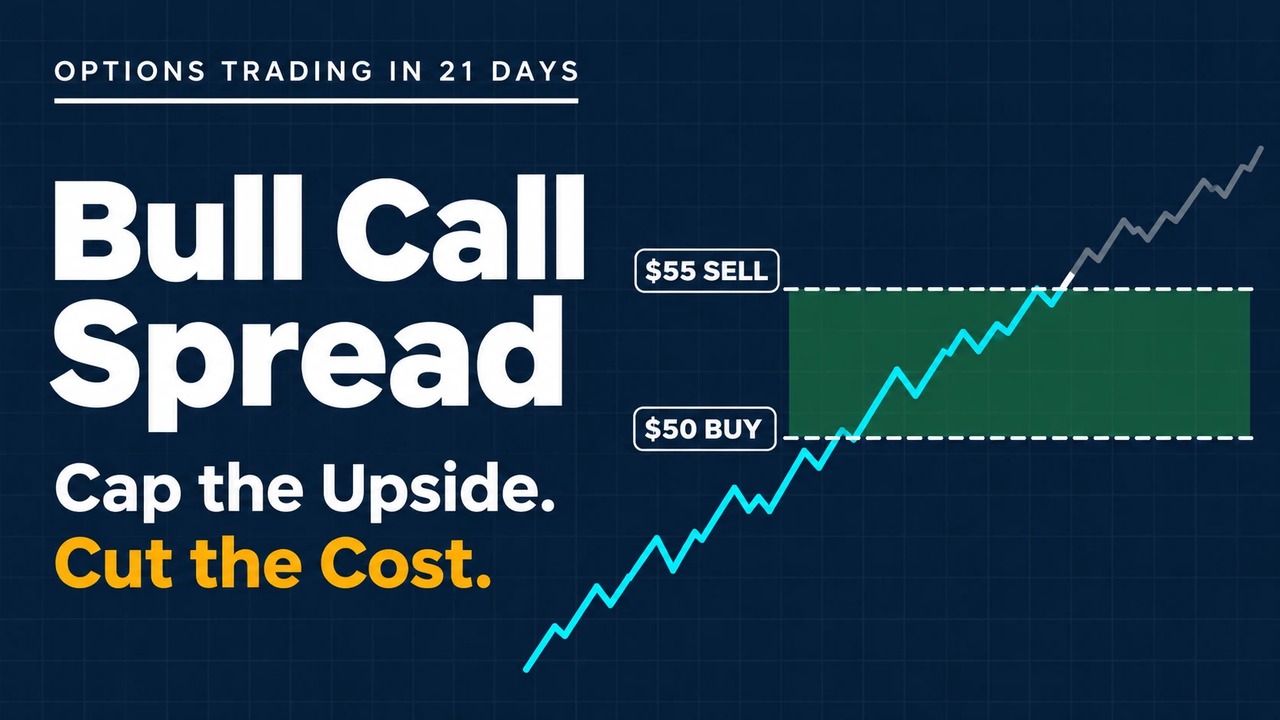
Most of what I teach on this site is about selling options and letting time work for you. But every trader eventually gets a strong bullish opinion on a stock, and when that happens you want a way to express it without handing a fortune to the option seller. The bull call spread is that tool. It is the first directional trade I put in front of students once they understand how a plain call works, and after 22 years of trading derivatives it is still the structure I reach for when I like a stock but do not expect a moonshot.
This article walks through what a bull call spread is, a worked example in dollars, how I pick the strikes and the expiration, and the one decision that matters more than any of the mechanics: when to use the spread, and when a straight call is the better trade.
Key Takeaways
✅ A bull call spread buys a call near the money and sells a higher-strike call with the same expiration. The sold call pays for part of the bought call.
✅ You trade away the upside above the sold strike in exchange for a lower cost, a lower break-even and a higher probability of profit.
✅ Maximum loss is the net debit. Maximum profit is the width of the strikes minus the debit. Both are known before you click.
✅ Use the spread when options are expensive and you expect a moderate move. Use a straight call when you expect a fast, large move or when implied volatility is already cheap.
✅ Make the spread wide enough to pay you. If you paid $5 for the long call, selling a call only five points higher leaves nothing to earn.
What a Bull Call Spread Is
A spread is simply buying one option and selling another to reduce the cost. For a bull call spread, also called a long call spread or a call debit spread, you buy a call at a lower strike and sell a call at a higher strike, both on the same stock and with the same expiration date. You pay a net debit, and that debit is the most you can lose.
The sold call is doing two jobs. It gives back some of the money you paid for the long call, and it caps how much you can make. That cap bothers some traders. I do not think you need to look at it that way. You are lowering your cost in exchange for giving up upside you probably were not going to see anyway, and in exchange you get a trade that works on a smaller move.
It is one of the four basic vertical spreads, and the bullish, debit-paying one. If you already sell put credit spreads, you know the structure from the other side: same two strikes, same defined risk, but here you are the one paying and you need the stock to move.
A Bull Call Spread Example in Dollars
Say a stock is trading at $50 and you think it drifts up to the mid-50s over the next couple of months, but you do not see it doubling. Here is the spread with 60 days to expiration:
⚡ Buy the 60-day $50 call for $3.00
⚡ Sell the 60-day $55 call for $1.20
⚡ Net debit: $1.80, or $180 per spread. That is your maximum loss.
⚡ Maximum profit: $3.20, or $320 per spread. That is the $5 width minus the $1.80 you paid, and you earn all of it if the stock is at or above $55 at expiration.
⚡ Break-even: $51.80. The long strike plus the debit.
Now compare that to just buying the $50 call outright for $3.00. The straight call needs the stock at $53 to break even, and it costs $300 instead of $180. The spread breaks even at $51.80 and costs $180. For a stock you expect to drift higher rather than explode, the spread needs less of a move and risks less money. The only thing you gave up is everything above $55. If the stock goes to $70, the straight call made a lot more. If the stock goes to $54, the spread made money and the straight call did not.
That is the whole trade-off, and the arithmetic is the same arithmetic covered in options break-even prices explained. Max loss is the debit. Max profit is width minus debit. Break-even is the long strike plus the debit. Nothing else to memorize.
How I Build One, Step by Step
📌 Direction first. If you are bullish, you want a call spread. If you are bearish, you want a put spread. Do not start with the structure and go looking for a stock to fit it.
📌 Time frame is the hardest part. You need enough time for the thesis to play out, but not so much that you are paying for months you do not need. If the catalyst is earnings 28 days away, I might go out 45 to 60 days. If the idea is a six-month story, I buffer and go out nine months. You can see every expiration side by side on the options chain.
📌 Buy near the money. For the long call I typically buy something around a 50 delta, right about at the money. That is the leg doing the work.
📌 Sell where you think the move stops. If you expect a 10% to 20% rise, walk up the chain to that price and sell the call there. The sold strike is your opinion about how far the stock goes, written into the trade.
📌 Make the width cover the debit. If you spent $5 on the long call, do not sell a call five points out of the money. You will not get anything back. You would need something ten points wide or more. The spread has to leave room to pay you.
📌 Size it as a full loss. The spread is cheaper than the straight call, and that is exactly how people get hurt. They decide they are so bullish, and the trade is so cheap now, that they risk 10% of the portfolio on it. Do not do that. Treat the debit as money that can go to zero, because it can, and keep it to a small slice of the account.
When to Use the Spread, and When to Just Buy the Call
This is the decision that separates a good directional trader from someone who just knows the definitions. The spread is not always better. It is better in specific conditions.
Use the bull call spread when:
⚡ Options are expensive. When implied volatility is high, the call you are buying is overpriced, and the call you are selling is overpriced by the same logic. Selling the higher strike offsets the rich premium you are paying.
⚡ You expect a moderate move. You think the stock goes up 10% or 15% in the time frame, not 50%. The cap costs you nothing if the stock was never going there.
⚡ You want a higher probability of profit. A lower break-even means more outcomes make money. You lose the home-run aspect, but you raise the odds of walking away with something.
Buy the straight call instead when:
⚡ You expect a strong, fast move. A catalyst, a new product, a possible buyout, whatever the reason. If the stock could run hard, do not cap it. Stay long and keep the full upside.
⚡ Options are already cheap. If implied volatility on the stock was 64 six months ago and it is 31 now, you are getting the call at a discount. The spread's main job is to cheapen an expensive trade, and this one is not expensive.
⚡ You genuinely do not know where it stops. If your view is "I love this stock and I think it keeps going higher," a sold strike is a guess you do not have to make.
For beginners, I think spreads win far more often than not. You get defined risk either way, but with the spread you are saving money on every trade, and there is an old saying that you never go broke taking a profit. Yes, sometimes the stock goes to $70 and you were capped at $55. You still made the full width. That is a good problem to have.
What Time Decay and Volatility Do to the Trade
A single long call is very sensitive to time decay because nothing in the position is offsetting it. Every day the stock sits still, you pay. The spread softens that. The call you sold is decaying too, in your favor, so the net position bleeds more slowly than a naked long call does. It does not stop the bleeding, and the spread still needs the stock to move, but it gives you more days for the thesis to work.
Volatility works the same way. A straight call loses value when implied volatility falls, even if the stock does what you hoped. Earnings are the classic case, which is the whole subject of IV crush explained. Because the spread is short a call as well as long one, a drop in volatility hurts the long leg and helps the short leg, and the net effect is much smaller. That is why the spread is my default when premiums are rich going into an event.
If you want the greek behind each of those effects, theta for time and vega for volatility, the options greek cheat sheet has them side by side.
The Two Mistakes I See Most
The first is oversizing, which I covered above. The cheaper price feels safer, so people buy more of it. A $180 spread that goes to zero is a $180 loss no matter how safe it felt.
The second is getting dangerous. Someone learns call spreads, put spreads and iron condors, gets comfortable, and then decides they are ready for butterflies, risk reversals and one-by-twos. They start chewing their account to bits because they ventured too far out too early. After more than two decades of doing this, the simple spreads perform better than the complicated ones. You have to be dead on with the complicated structures, and the market usually does something different from what you expect. The bull call spread is simple. Get good at it before you go looking for the next thing, and if you are working with a smaller account, the small account strategies article shows where it fits.
The Options Industry Council publishes a clean payoff diagram for the bull call spread, and Cboe's education library covers the margin and assignment rules for spreads. Both are worth a read before you place the first one with real money.
Frequently Asked Questions About Bull Call Spreads
What is a bull call spread?
A bull call spread buys a call option at one strike and sells a call option at a higher strike, both with the same expiration. You pay a net debit, which is your maximum loss. It profits when the stock rises, with the gain capped at the higher strike. It is also called a long call spread or a call debit spread.
What is the maximum profit on a bull call spread?
The width between the two strikes minus the net debit you paid. On a $50/$55 spread bought for $1.80, the maximum profit is $3.20 per share, or $320 per spread, earned if the stock closes at or above $55 at expiration.
Is a bull call spread better than buying a call?
It depends on the move you expect. The spread costs less, breaks even sooner and holds up better against time decay and falling volatility, so it wins when you expect a moderate rise. A straight call keeps unlimited upside, so it wins when you expect a fast, large move or when options are already cheap.
How wide should a bull call spread be?
Wide enough that the maximum profit is meaningfully larger than the debit. If the long call costs $5, selling a call five points higher leaves little or nothing to earn. Place the sold strike where you think the stock stops rising, and make sure the width leaves real room above your cost.
Can you lose more than you paid on a bull call spread?
No. The net debit is the maximum loss, because the long call always covers the short call. The one thing to watch is early assignment on the short call near expiration if it is deep in the money, which your broker will handle by exercising the long call against it.
Learn to build and size every spread on live chains: the Options Trading in 21 Days course.
Final Thoughts
The bull call spread is the trade for a bullish opinion with a realistic ceiling. You give up the lottery ticket and in exchange you get a lower cost, a closer break-even, and a position that does not fall apart the moment the stock pauses. Pick the direction, pick a time frame that fits the thesis, buy near the money, sell where you think it stops, and size it as a full loss.
Then do it again. A good directional trade is useful. A repeatable process for finding and structuring them is what actually builds an account.
Keep Learning
📘 Vertical Spreads Explained: The Four Types and When I Use Each
📘 Call Options for Beginners: A Clear, Practical Guide
📘 Mistakes Beginner Options Traders Make: What Not to Do
Trade direction with defined risk and a plan: the Options Trading in 21 Days course.
Stay Connected!
Join our mailing list to get notified of all new blog posts, and receive the latest news and updates from our team.
